Reverse Graffiti – My Relationship with a Technique
About fifteen years ago, my career as a street artist in public spaces began with the development of my own reverse graffiti technique. During this early phase, I gained my first practical experience in an urban setting. I also received feedback from law enforcement officials and learned how to interact with the police and the media. These encounters were formative and sharpened my awareness of the impact of art in public spaces. Even though I partially reoriented myself artistically after a few years and incorporated other techniques and forms of expression, reverse graffiti never left me. The method remained a constant companion to my work. Moreover, it kept returning as a conceptual and creative point of reference.
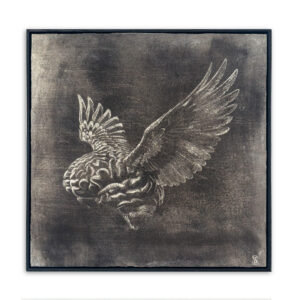
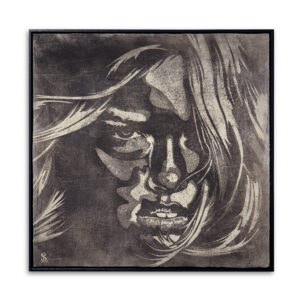
In recent years, I have experimented intensively with materials and surfaces, exploring their properties. Concrete, as a symbol of urban space and the medium for many of my works, has become a daily companion in the studio. Its materiality, its weight, and its direct connection to the city’s architecture make it an ideal medium for my artistic content.
The evolution of concrete surfaces as an artistic backdrop now meets the requirements to serve as a medium for reverse graffiti — a decisive step toward transferring this technique, which originated in urban spaces, into a new context and thereby making it accessible to the art market. The compromise I have found between light weight and sufficient stability, between density and resilience, now allows me to work with concrete in such a way that reverse graffiti can be realized on this material, which is central to my practice. This creates a direct connection between the origins and the evolution of my work: from public space to the studio and back into a new artistic context.
What is reverse graffiti, and how does this technique work?
Reverse graffiti is a non-additive form of street art in which a motif is created not by applying paint, but by selectively removing dirt from soiled surfaces. Using water, brushes, stencils, or pressure washers, previously soiled areas are partially cleaned, revealing the motif as a contrast between cleaned and uncleaned sections. The technique thus uses the existing dirt as a creative material and makes the condition of the urban space itself a component of the image. Symbolically, reverse graffiti carries a special meaning: the act of cleaning becomes an artistic process. The removal of dirt can be understood as a metaphor for renewal, revelation, and transformation — an intervention that does not destroy but rather reveals. In this sense, reverse graffiti represents not only an aesthetic technique but also an attitude: the act of revealing hidden structures and the possibility of opening up new perspectives on urban space through deliberate change.